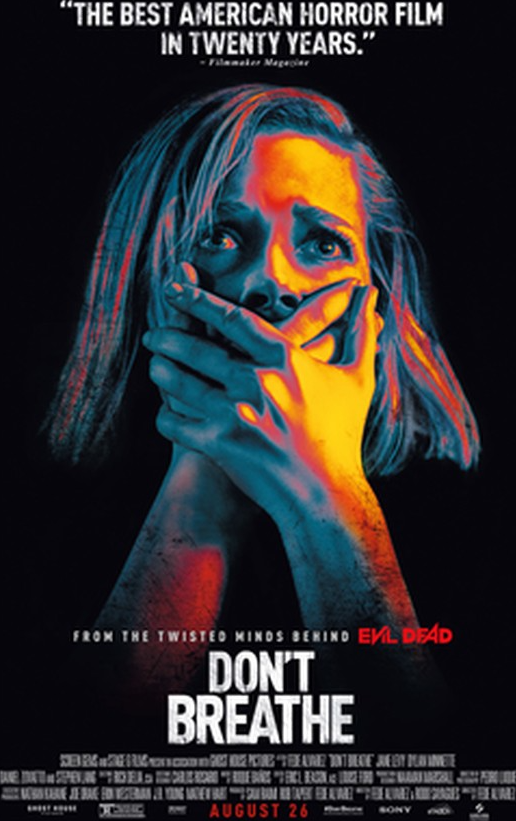
The Year in Order
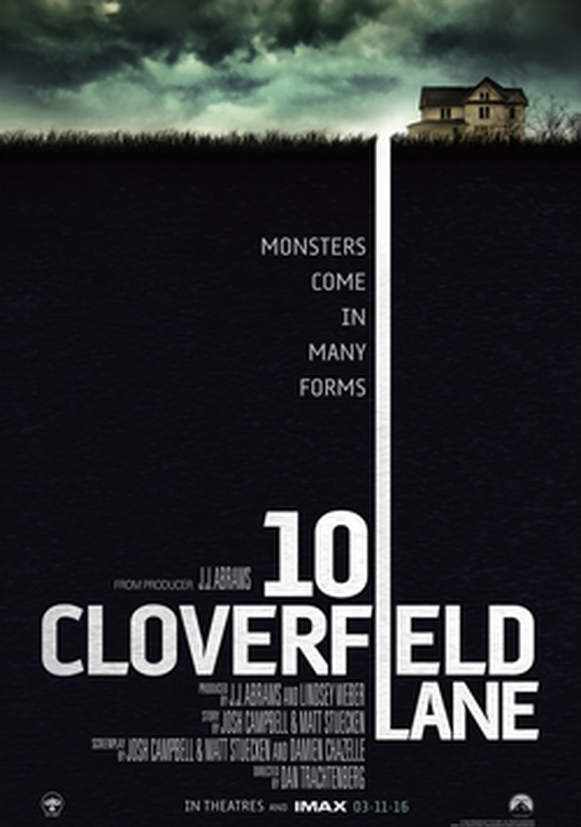
10 Cloverfield Lane (March 2016) opened the year with a masterstroke of misdirection: produced by J.J. Abrams's Bad Robot for Paramount and directed by Dan Trachtenberg in his feature debut, it spent most of its running time as a three-person chamber thriller before detonating its genre credentials in the final act. The minimal cast and near-single-location shoot made it the most cost-efficient surprise of the multiplex calendar.
The Invitation (April 2016) arrived through Drafthouse Films after festival circulation, directed by Karyn Kusama from a script by Phil Hay and Matt Manfredi. A dinner-party thriller sustained entirely on ambient dread, it built its unease through social obligation rather than shock, and earned a reputation on the festival circuit that outlasted its limited release.
The Shallows (June 2016) was the year's clearest genre-mainstream crossover: director Jaume Collet-Serra for Columbia Pictures, with Blake Lively as effectively a solo performer stranded on a rock two hundred yards from shore. Box Office Mojo records a domestic gross of roughly fifty-five million dollars against a production budget of around seventeen million — survival horror with real commercial reach.
Blair Witch (September 2016) was Lionsgate's attempt to restore the found-footage franchise, directed by Adam Wingard from a Simon Barrett script. The film's existence had been concealed under the working title The Woods until its Midnight Madness premiere at Toronto, but the concealment turned out to be more interesting than the film itself: reviews were mixed and the theatrical performance well below the original's cultural footprint.
I Am the Pretty Thing That Lives in the House (October 2016) reached audiences through Netflix, directed by Oz Perkins. Deliberately literary in pace, structured around a narrator who announces her own death at the outset, it divided opinion sharply — praised for atmosphere, criticised for inertia — but established Perkins as a filmmaker operating at a distinct remove from genre convention.
The Eyes of My Mother (November 2016) was shot in black and white by Nicolas Pesce for Magnet Releasing. Made on a budget that would not cover a single day on a studio picture, it traced a sequence of violence and isolation on a rural farm with a formal rigour that placed it immediately in a lineage running from early Fassbinder through to Lynne Ramsay.
Its placement in any horror list is a critical decision, not a generic one — and that ambiguity is part of its record.
Split (premiered at Fantastic Fest in September 2016, released January 2017) reunited M. Night Shyamalan with Jason Blum's Blumhouse Productions for a story of dissociative identity disorder weaponised as monster mythology. James McAvoy's performance across multiple personalities drove it to a domestic gross that made it one of Blumhouse's highest-returning films to that point.
Three films from 2016 arrived from beyond the English-language mainstream and proved consequential in proportion to their scale. Under the Shadow (Sundance 2016, UK release October), directed by Babak Anvari, set a djinn-possession narrative inside a Tehran apartment during the Iran–Iraq War: a British-Iranian co-production that worked the Sundance Film Festival and took the BAFTA Outstanding British Film nomination, unusual territory for a horror film. Raw (Grave in its original French), directed by Julia Ducournau, premiered at Cannes in Critics' Week and toured Fantastic Fest before Focus Features acquired it for North American distribution. Its cannibalism narrative doubled as a coming-of-age study and placed Ducournau squarely in the conversation that would eventually reach the Palme d'Or. The Autopsy of Jane Doe, directed by André Øvredal and released in the United States through IFC Films in December, confined its procedural horror almost entirely to a father-and-son mortuary and demonstrated that a near-zero location count could generate sustained tension across a feature runtime.
Nicolas Winding Refn's The Neon Demon (June 2016, Amazon Studios and Wild Bunch) sits at the genre's contested edge: a Los Angeles model-industry nightmare that drew on horror's visual language without submitting to its structural conventions. Festival response at Cannes was polarised.