
Expanding a Competition Win into a Feature Architecture
The answer Wadlow and Bauman settled on was a prep-school slasher organised around a social deduction game — a structure that did not originate in the short itself but in the dramatic logic they wanted to explore. The game they borrowed was Werewolf, also known as Mafia, in which players with concealed roles try to identify a hidden threat through a sequence of accusations and votes. The genre had migrated from Soviet psychology research into campus dorm rooms by the early 2000s, and its central mechanism — accusation as entertainment, lying as competitive strategy — mapped cleanly onto adolescent social hierarchies. Transplanting it to a boarding school gave the writers a closed community, a set of characters already versed in performance and self-presentation, and a physical architecture that a slasher could exploit without contrivance.
The killer-in-the-text device came next. The screenplay's inciting move — a group of students composing a collective fiction about an invented serial killer and distributing it via text message — gave the film its intellectual engine. The fictional killer, named The Wolf, is constructed with enough detail to circulate as urban legend: a description, a method, a history. The students believe they are playing. The structure of the narrative, of course, insists they are not, or at least that the gap between invention and reality is narrower than they assume. What the screenplay inherited from Aesop's fable — the boy who manufactures a threat until the real one materialises — it filtered through a specifically early-2000s form of social technology: the mobile phone as rumour-delivery mechanism.
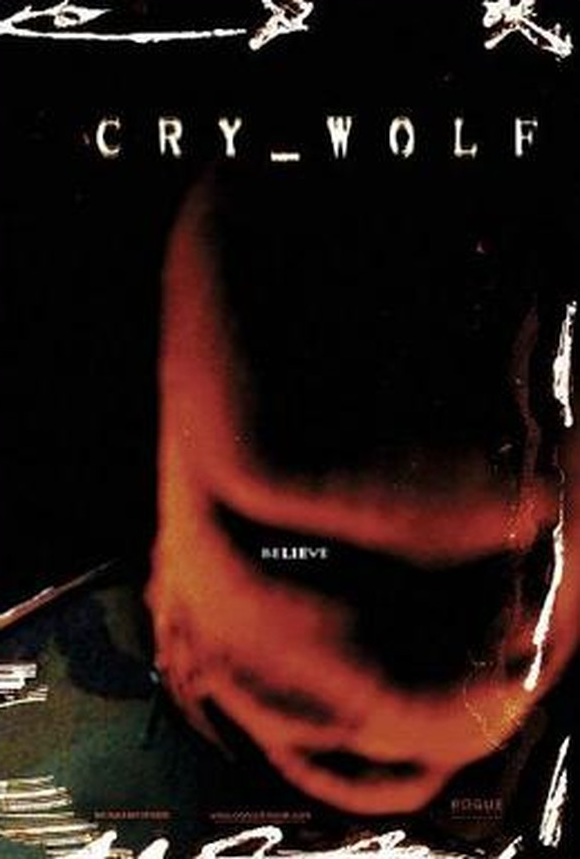
That device gave the film a dateable texture, but it did not date the underlying architecture. The liar's game and the sealed community are durable forms. Wadlow and Bauman's structural decision was to keep both in permanent tension: every scene in which a character might be lying is also a scene in which a character might be dying, and the film never resolves which register it is operating in until the final act. The prep-school setting reinforces this because privilege and performance are already the institution's currencies — a student who lies convincingly is simply a student who has internalised the school's own logic.
Casting deepened the architecture rather than decorating it. Julian Morris, making his feature debut as the new arrival Owen, needed to carry sufficient ambiguity to sustain the audience's uncertainty about his reliability. Lindy Booth's Dodger required the opposite pressure: a character whose apparent trustworthiness becomes the film's central trap. The ensemble around them — which would eventually include Jared Padalecki and, in the film's most unconventional piece of casting, Jon Bon Jovi as a journalism teacher — was drawn from a generation of young actors working across television and early-career film roles. The casting aligned with the screenplay's own strategy: familiar enough to be credible, uncertain enough to be suspect.

The University of Richmond, where principal photography took place, provided something the screenplay needed but could not manufacture on a constrained budget: genuine collegiate Gothic architecture, with stone facades, chapel interiors and residential corridors whose symmetry a camera could weaponise. The campus's Cannon Memorial Chapel in particular offered the film its most legible visual grammar — a space that reads as ancient, institutional and inescapable even to an audience encountering it for the first time.
Wadlow and Bauman had learned, under competition conditions, to make every narrative element earn dual function. In Cry Wolf, that principle held: the game is also the plot; the setting is also the trap; the text message is also the murder weapon. The short had proved they could compress. The feature proved they could sustain compression across ninety minutes without releasing the pressure too early.