The Year He Occupied Both Ends of the Room
Mike Flanagan entered 2016 as one of American horror's more precisely calibrated craftsmen — Oculus (2014) and Hush (2016) already behind him — and closed it having released two features that together spanned almost the full range of what genre filmmaking could look like economically. Hush arrived on Netflix in April 2016, a Blumhouse Productions co-production shot on a tight budget with a cast so small it barely required a roster. Ouija: Origin of Evil opened in cinemas that October through Universal and Blumhouse, inheriting a franchise that had earned well at the box office and needed a filmmaker willing to treat the material seriously rather than manage it.
What is striking, placed together, is how little the difference in scale changed Flanagan's preoccupations. Hush reduces its own scenario to the geometric minimum: a deaf novelist isolated in a rural house, a masked killer circling outside, and a formal problem — how to stage sustained tension for a protagonist who cannot hear the standard apparatus of the horror film. Flanagan co-wrote the script with his partner and lead actor Kate Siegel, and the film plays as an exercise in the siege-film logic stripped to its elements. There is no mythology, no backstory of consequence, no final twist recontextualising what preceded it.

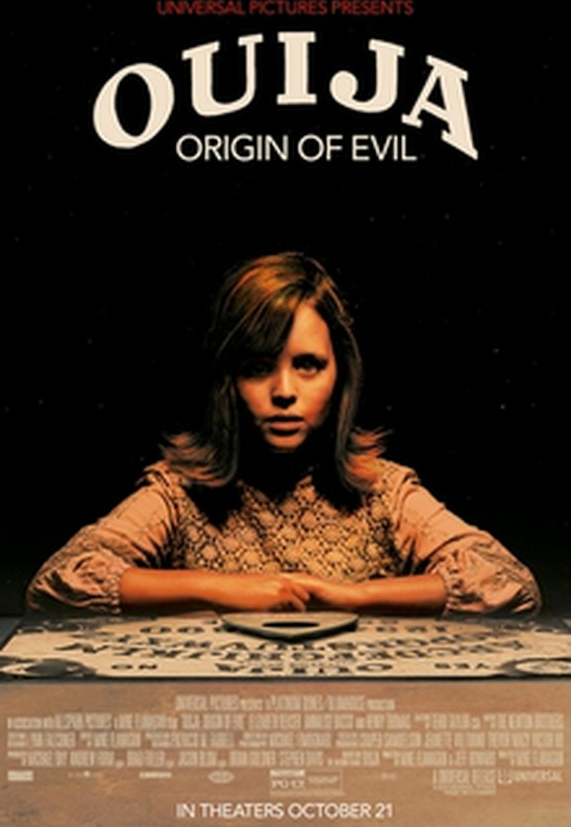
Ouija: Origin of Evil works from the opposite direction. It inherits a mid-century setting — Los Angeles, 1967 — and uses period production design, anamorphic-style framing, and vintage Universal title cards to argue that a Ouija board belongs inside a domestic grief story rather than a teen-fright commodity. The film follows a widowed mother and her two daughters, and Flanagan's real subject, as in almost everything he has made, is the way the dead exert structural pressure on the living. Lulu Wilson's performance as the possessed younger daughter operates in the same register as the best work of the Italian supernatural tradition — control yielding to something else across a single held frame.
Neither film pretends to be the other. Hush is a machine; Ouija: Origin of Evil is an atmosphere. But both demonstrate that Flanagan's formal commitments — the long take, the precisely timed sound design, the willingness to let a scene breathe past the obvious cut point — survive the move between a Netflix micro-production and a studio genre exercise. According to Box Office Mojo, Ouija: Origin of Evil opened to around $14 million domestically, outperforming its predecessor critically by a substantial margin. Two different kinds of reach; one sustained sensibility.